We held the first potluck of the GW Community Garden this evening. The weather was perfect, and we had a great spread, including some garden grown produce! It's nice getting to know our neighbors and fellow members at functions like these, and it really highlights the community aspect of GW Community Garden. Looking forward to more get togethers in the garden soon!
Sunday, June 23, 2019
Saturday, March 16, 2019
The Start into Spring 2019
Thanks all for coming out to kick off the 2019 season! The beds are looking good, and look forward to our first spring harvest! Next garden session will be March 24th at 3pm; hope to see you there.
Sunday, March 18, 2018
And so it begins...
We are excited to be in the garden again and getting ready for the 2018 growing season!
We spent a lot of time last Sunday, clearing out the beds; getting the raised beds filled in with soil and compost; and generally getting things ready for the year.
We have several new members this year, and many returnees! If you are interested in joining us this year, please contact us via email!
We spent a lot of time last Sunday, clearing out the beds; getting the raised beds filled in with soil and compost; and generally getting things ready for the year.
We have several new members this year, and many returnees! If you are interested in joining us this year, please contact us via email!
Friday, May 20, 2016
Keeping Bees Fed after September
All types of bees (honey, Mason, bumble, etc.) need nectar & pollen for food. However, most flowers in gardens begin fading in September. But bees are active to December (weather permitting), and they'll start foraging again in January (weather permitting). So the best plants for your garden (if you want to help bees) are late bloomers. Using the site www.Wildflower.org, here's a list of late-blooming wildflowers that are native to the mid-Atlantic, especially Virginia. Plant some of these and keep our pollinators fed! Our honeybees say, "Thanks!"
Asters
![]() |
| Credit |
Asters
Bee
Balm (Bergamot)
Blue
Mistflower
Cardinal
Flower
Carolina
Phlox
Coneflowers
Great
Blue Lobelia
Appalachian Bugbane
Wild
Geraniums
Witch Hazel
Friday, May 6, 2016
Get Ready for the Cicadas!
It's that time again when the cicadas descend upon the Mid-Atlantic region. Technically, they will ascend, crawling out of the soil next month for what is expected to be their 17-year mating cycle. Get ready for the cacophony in the trees as these bugs try to impress their mates and the crunching underfoot (yes, it can be unnerving). But don't be turned off by cicadas. They won't decimate our veggies like locust.

Image courtesy of Wikipedia
Cicadas are fascinating little creatures, and not well understood. Yet they have a lot of meanings and symbolize immortality, rebirth, love, and good luck. You can even eat them, like in East Africa, where cicadas are considered a delicacy.
Since we will all see them in the coming weeks, whether in the garden or underfoot, here are some FAQs about cicadas and the 17-year cycle in the Northern Virginia area:
Sources:

Image courtesy of Wikipedia
Cicadas are fascinating little creatures, and not well understood. Yet they have a lot of meanings and symbolize immortality, rebirth, love, and good luck. You can even eat them, like in East Africa, where cicadas are considered a delicacy.
Since we will all see them in the coming weeks, whether in the garden or underfoot, here are some FAQs about cicadas and the 17-year cycle in the Northern Virginia area:
- Cicadas can’t chew so they don’t devour our plants and trees. They suck sap, but generally not enough to do any long-term damage to mature vegetation.
- A single generation of cicadas can reach a density of 1.5 million cicadas an acre in some areas.
- The adults live above ground for four to six weeks focused solely on mating and laying eggs (that won't hatch for 17 years!).
- The sound you hear when the cicadas emerge is the mating cry sung by males, as they try to find females.
- Cicadas begin to emerge when the soil 8" beneath the ground reaches 64 degrees Fahrenheit.
- Cicadas are not really related to the locusts that we tend to compare them to. They are more closely related to leafhoppers and spittlebugs.
- Twelve of the 15 known cicada broods emerge from the ground after 17 years. The other three emerge after 13 years. The two types will only emerge together once every 221 years.
Sources:
http://www.wsj.com/articles/its-prime-time-for-cicadas-natures-numerical-nerds-1462535749
https://www.washingtonpost.com/news/morning-mix/wp/2016/04/15/billions-of-cicadas-will-descend-upon-the-northeastern-united-states-as-another-17-year-cycle-conclude/?hpid=hp_no-name_morning-mix-story-h%3Ahomepage%2Fstory
http://www.insidenova.com/news/local/northernva/fascinating-facts-about-cicadas/article_f9a8fda6-bdda-11e2-96d8-001a4bcf887a.html
http://www.gardensalive.com/product/the-cicadas-are-coming-the-cicadas-are-coming/you_bet_your_garden
Thursday, April 28, 2016
Spring means Beans (and Wood Chips)! Guest post by Aidia
This last Sunday in April couldn’t
have been more perfect! The DC area has a funny way of moving quickly from
winter right into the summer. But not today… the sun was shining and the temp
was right around 70 degrees: An ideal day to work in the garden.
The first thing I noticed as I arrived at the school were the garden men hard at work! We received a huge pile of woodchips this past Friday to spread around the garden space. Their shovels were digging and the wheelbarrows were moving. That pile of woodchips didn’t stand a chance!
As the men and children transported the woodchips to the walkways, several different projects were simultaneously being undertaken. I’m accustomed to community gardens that are more like rental gardens in the community, without much collaboration besides a spring clean-up and a fall clean-up. Even then, gardeners are ready to scurry back into their respective plots to tend to their own business. You do get the occasional passerby who wants to share his/her war stories with cucumber beetles, but for the most part you are on your own.
This Sunday I saw gardeners working together and sharing knowledge; not just about plants and flowers, but world travels, delicious wines and how to brew your own liqueur for cocktails, just to name a few things overheard. There are so many cool and interesting things you can learn from your neighbor. That is what a community garden should be about, right? Gardening is hard work! Why not have fun at the same time?
My first task was weeding. The most dreaded task of them all! But I like to concentrate on each little weed and try to pull up every bit of the root without it snapping. Usually this takes me FOREVER! Luckily I got some help from Amber who also showed me where the Asparagus plants are, that we hope comes back to life. I soooo hope they come back! Asparagus is one of my favorite veggies to prepare because they are so simple and hearty.
After weeding Amber and I planted nasturtium seeds. These plants are easy to grow and both the leaves and flowers are edible. Traditionally, the blooms range from bright yellow to orange and have a sweet and peppery taste. Not only can they be used as a yummy garnish, but they can be used in salads, sandwiches, vinaigrettes or whatever dish you want to spice up. Can’t wait to try these!
My next task was transplanting
Pink Tip Greasy Beans and Robert Hazelwood Beans (both are Appalachian heritage beans, available online at Sustainable Mountain Agriculture. I’ve never been an artist or been able to draw
straight lines, so I’m sure the plants are not in a perfect row. But, I’m
pretty sure that won’t affect their growth. Again, I’m all about the roots,
so I made sure to handle each seedling so that the roots stayed intact.
Fingers crossed they make it through the transition.
The last task of the day was constructing trellises for the varieties of beans to climb. This was truly a collaborative effort. We used old sections of wired fences, old bamboo sticks and twine to hold the structure together. With the many hands on deck, the innovative engineering and sound decision making, the beans will have something to hike up.
Next work session, Sunday May 1st, 1:00-4:00pm will be the first garden potluck of the season! After some socializing, we will plant more veggie plants as well as regular maintenance tasks. Looking forward to seeing everyone!
The first thing I noticed as I arrived at the school were the garden men hard at work! We received a huge pile of woodchips this past Friday to spread around the garden space. Their shovels were digging and the wheelbarrows were moving. That pile of woodchips didn’t stand a chance!
As the men and children transported the woodchips to the walkways, several different projects were simultaneously being undertaken. I’m accustomed to community gardens that are more like rental gardens in the community, without much collaboration besides a spring clean-up and a fall clean-up. Even then, gardeners are ready to scurry back into their respective plots to tend to their own business. You do get the occasional passerby who wants to share his/her war stories with cucumber beetles, but for the most part you are on your own.
This Sunday I saw gardeners working together and sharing knowledge; not just about plants and flowers, but world travels, delicious wines and how to brew your own liqueur for cocktails, just to name a few things overheard. There are so many cool and interesting things you can learn from your neighbor. That is what a community garden should be about, right? Gardening is hard work! Why not have fun at the same time?
My first task was weeding. The most dreaded task of them all! But I like to concentrate on each little weed and try to pull up every bit of the root without it snapping. Usually this takes me FOREVER! Luckily I got some help from Amber who also showed me where the Asparagus plants are, that we hope comes back to life. I soooo hope they come back! Asparagus is one of my favorite veggies to prepare because they are so simple and hearty.
After weeding Amber and I planted nasturtium seeds. These plants are easy to grow and both the leaves and flowers are edible. Traditionally, the blooms range from bright yellow to orange and have a sweet and peppery taste. Not only can they be used as a yummy garnish, but they can be used in salads, sandwiches, vinaigrettes or whatever dish you want to spice up. Can’t wait to try these!
My next task was transplanting
Pink Tip Greasy Beans and Robert Hazelwood Beans (both are Appalachian heritage beans, available online at Sustainable Mountain Agriculture. I’ve never been an artist or been able to draw
straight lines, so I’m sure the plants are not in a perfect row. But, I’m
pretty sure that won’t affect their growth. Again, I’m all about the roots,
so I made sure to handle each seedling so that the roots stayed intact.
Fingers crossed they make it through the transition. The last task of the day was constructing trellises for the varieties of beans to climb. This was truly a collaborative effort. We used old sections of wired fences, old bamboo sticks and twine to hold the structure together. With the many hands on deck, the innovative engineering and sound decision making, the beans will have something to hike up.
Next work session, Sunday May 1st, 1:00-4:00pm will be the first garden potluck of the season! After some socializing, we will plant more veggie plants as well as regular maintenance tasks. Looking forward to seeing everyone!
Wednesday, April 13, 2016
It's supposed to be SPRING, right!?!
Last Sunday's work session followed several nights of late-season frosts and even a freeze. We were pleasantly surprised that not only was the weather warmer than predicted during our work, but also the transplants from last week seemed fine with the cold snap and the soil warm enough for more seeds. Yay for more spring planting!
Throughout the beds many varieties were planted: a spicy greens mix and a sweet greens mix; parsley and cilantro (in a part-shade section of the garden to help ward off bolting too early as temperatures rise); rainbow chard; and a mix of edible flowers in the asparagus patch.
There was a good bit of "maintenance weeding" in all the beds. A couple folks undertook cleaning out and organizing the garden shed. Thanks to Dee for putting up plot markers!
The lettuce and arugula planted a couple weeks ago have sprouted!! There is life with the sugar snap peas, and the strawberries have started to set early blooms for their sweet, sweet fruit: strawberry shortcake, here we come!!
Next work session, Sunday April, 17th, 2-4pm will involve more weeding and, if it's WARM enough (come on spring!!), herbs will be planted. The big summer planting will need to wait until May 1st, 2-4 (which is also our next COMMUNITY DAY), because the weather has been so unpredictable.
Lastly, we have a "call for materials." We are going to construct raised beds along the entry side walk, and we need anything that could help: stakes to hold up the walls, extra wood, plastic, or metal boards or planks: if you have something laying around that you think, but are not sure, if it would be useful, just ask!
Great work everyone!
Wednesday, April 6, 2016
Spring may be slow to warm, but our garden is well under way!
Sunday, April 2nd was our second all-hands work session and we got so much accomplished! The weather was warmer and less windy than predicted and several folks stayed past 4pm to start laying cardboard in the paths and water the last of the plantings.
Backing up two hours, I (among many others) was met on the street with hot apple cider and name tags. We started with the big weeding projects of the day: clearing the mostly-wire-grass weeds from the asparagus patch, the pollinator garden spot, the hole that was last year's attempt to catch heavy rain fall from the school roof, and any visible weeds in the other veggie beds.
A team also worked on filling that ex-water-hole with dirt and getting it ready to be planted over.

Then there was all the SPRING PLANTING! A variety of potatoes (including PURPLE ones!) were put in, as well as plenty of different types of carrots, radishes, and peas in various spots around the garden. The kale transplants looked good, and only a few of last session's sugar snap peas had sprouted, so those rows got reseeded.


The strawberries in particular looked strong and notably larger than a mere two weeks ago. I can't wait to see what has sprouted come the next work session, this Sunday, April 10th, 2-4pm!
A team also worked on filling that ex-water-hole with dirt and getting it ready to be planted over.
Then there was all the SPRING PLANTING! A variety of potatoes (including PURPLE ones!) were put in, as well as plenty of different types of carrots, radishes, and peas in various spots around the garden. The kale transplants looked good, and only a few of last session's sugar snap peas had sprouted, so those rows got reseeded.
The strawberries in particular looked strong and notably larger than a mere two weeks ago. I can't wait to see what has sprouted come the next work session, this Sunday, April 10th, 2-4pm!
Monday, March 21, 2016
Spring Has Arrived!
What better way to welcome Spring than to begin working on the GW Community Garden! Despite the "non-Spring" weather, the team made great headway during our first gardening session of the year. The rain and cool air didn't deter us - warm apple cider and cookies certainly helped! All hands were on deck to weed plots, turn the soil, and make sure that stubborn wire grass was completely removed from the beds. We loaded many large bags filled to the brim with weeds. And with the fresh plots, we were able to plant peas and lettuce seeds. It was a very satisfying and productive day!
We are very fortunate to have such a diverse group! Some have been playing around in the dirt for many years while others are new to gardening and working to turn that thumb green. But no matter the level of experience, everyone is very excited and looking forward to a fantastic and fruitful season that lays ahead! - Julie Y.
Next gardening session is April 3rd.
Friday, March 11, 2016
Zinnias to be the First Life on Mars? and All Invited to Info Session!
Starting off the gardening year with a reference to Bowie, RIP! But how would you grow crops on deep-space missions (Mars, for instance)? Think about it: seeds are a lot easier to carry than food, and if you can figure out the water reclamation part, you're golden.
Of course they're wondering about that at NASA, and trying things out on the International Space Station. Here's a recent post, Flowers Harvested on the Ground & in Space.
A little closer to home, you're invited to an info session for all interested in the GW Community Garden. It will be at Stomping Ground, 2309 Mt. Vernon Avenue in Del Ray. Tuesday, March 15, 2016, 7pm. Stomping Ground is one of our community partners, and are opening up especially for our meeting. Get there early to buy & try out their excellent selection of coffee & pastries.
We have exciting plans for this year's garden and look forward to sharing our ideas and reconnecting with you all at the information session. Find out what your commitment is, what the cost to join is, and what we hope to achieve as a community garden.
Of course they're wondering about that at NASA, and trying things out on the International Space Station. Here's a recent post, Flowers Harvested on the Ground & in Space.
A little closer to home, you're invited to an info session for all interested in the GW Community Garden. It will be at Stomping Ground, 2309 Mt. Vernon Avenue in Del Ray. Tuesday, March 15, 2016, 7pm. Stomping Ground is one of our community partners, and are opening up especially for our meeting. Get there early to buy & try out their excellent selection of coffee & pastries.
We have exciting plans for this year's garden and look forward to sharing our ideas and reconnecting with you all at the information session. Find out what your commitment is, what the cost to join is, and what we hope to achieve as a community garden.
Friday, September 4, 2015
Space Veggies!
My brain is totally post-apocalyptic these days, so besides being addicted to Walking Dead, I'm also reading Seveneves. I spend a lot of time wondering how I'd deal with one of these situations. I expect I'd be really useful if cowering & screaming are required.
Anyway, NASA and the International Space Station have taken care of one important issue, which has come up in Seveneves: how to grow veggies in space?! (The Martian also deals with this important issue.) Read more about the plant pillow here. Keep eating those veggies & have a great end-of-summer long weekend.
Wednesday, July 8, 2015
West Nile Virus - Another Reason to Go Native!
Brief post here to remind you that if you're working on fixing up your yard, it's best for the local birds & bees if you go native (native plants, I mean). But now there's another reason: new research showing that non-natives seem to make it easier for nasties like West Nile Virus mosquitoes to thrive! Which makes sense, right? If you give them the plants they are used to, they'll feel right at home. I'm fairly hospitable, but I do draw the line at evil disease-spreading non-native insects. So, the paper, Asymmetric effects of native and exotic invasive shrubs on ecology of the West Nile Virus vector Culex pipiens (Diptera: Culicidae), is a slog if you're not a biologist, so I just read the abstract.
If you're not sure what/how to find natives for your area, the Lady Bird Johnson Center for Wildflowers (www.wildflower.org) is an excellent starting place.
| Credit |
Tuesday, June 16, 2015
Beekeeping Update
Honey on the comb! Yep, that's what it looks like. You can see that most of it has been "capped," meaning covered with beeswax, but there are a few cells uncapped, and we tasted it and it's definitely honey. At this point it's made from sugar water we were feeding them when they first arrived, so it's not really tasty. We care, but the bees don't; it's food that they can store for the winter. We'll be looking for the honey they're making in the next few months, which will be from the nectar & pollen they're collecting now. It will be a richer color & flavor (we hope)! I'll be sure and keep you updated as our first beekeeping season progresses...
Labels:
apiary,
bee-keeping,
beekeeping,
hive,
honey,
honey-bees
Friday, May 1, 2015
Grow charts!
Our third President was interested in the same things we are: eating well, fresh veggies, and when will watermelons and asparagus be available?!
Check out the link above for the full blog post, entitled The President & the Parsnip, at the Library of Congress website.
For comparison purposes, here's a chart from the Virginia Cooperative Extension showing the same info.
BTW, the VCE is a great place to get lots more info about gardening, and they also have a help line if you've got a difficult question. The Master Gardeners of NoVA also have plant clinics at the farmer's markets in Alexandria & Arlington. For example, they'll be at the Del Ray Farmer's market starting 5/3/15 and will be there every Saturday through September.
Labels:
Jefferson
Tuesday, April 14, 2015
Tales from a Beginning Gardener – Loading up on Supplies
Gloves,
Check. Hoe, Check. Shovel, Check. Baseball hat and water bottle? Check check. Overalls?
Check, wait just kidding I’m not really wearing overalls. Ok I’m ready for my
first day of gardening! Can’t be too hard right? Let’s back up for a minute.
I went to Culinary School for the past year and a half and in that time I spent a ton of time with food. We were in class reading about food, watching videos about food, baking off food, prepping food, and then going home and dreaming about food and where it comes from. That is a lot of food time! I have always had a passion for baking and food but through my journey at Culinary school I really began to think more about where food comes from and the process people take to obtain it.
I had searched community gardens in Alexandria, VA on the web and found GW Community Garden. I saw that the application submission period was already closed for 2015. I made a power fist at this point and yelled out “No!!!!! I want to plant Lima beans!” Living in a tiny apartment in Old Town with no yard is not conducive to gardening so I had hoped I would be able to join a community garden. I sent an email to GW Community Garden asking if they take volunteers as a Hail Mary attempt. I think in my email I stated, I won’t take any produce, I promise I will work really hard and I just want experience gardening. A couple of hours later I received a response, “We had a cancellation would you like to join?” I immediately accepted and then began compiling my gardening gear.

I have only been gardening for a couple of weeks; at this point I am probably the most amateur gardener of 2015. Already I have learned so much and I feel accomplished as little buds begin to appear above the dirt. I have helped fill up wheelbarrows with chips and pour it on the wire grass. I have planted some seeds and even weeded! Everyone has been so nice and helpful so far and thank goodness no one has judged my amateur questions and comments of “How do you open these seed packets?” “What does a weed look like?” and “Please don’t tell anyone that I knocked over the wheelbarrow full of chips!” I feel very welcome and am so happy to help in this experience. Each week I learn a little more and get a tiny bit more comfortable in the garden. Perhaps so comfortable that at some point this summer I will break out my overalls, well let’s not get ahead of ourselves, let’s see how my first watering shift goes. Are you a beginning gardener? What are the biggest challenges you have faced thus far? Is it figuring out how many seeds to put in each row? Let me know!
Happy Gardening!
Friday, April 3, 2015
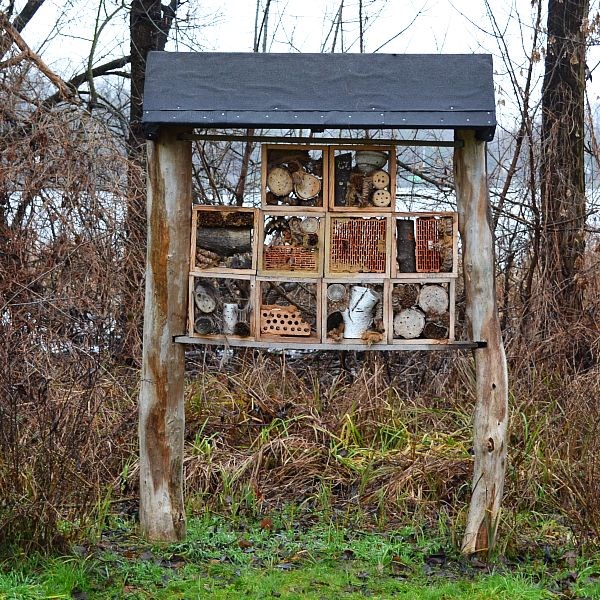
Ta-Da! Insect Hotel Finished
Would you say my influences are Frank Lloyd Wright or I.M. Pei? Or Freecycle?
Whatever, I finished the insect hotel for our backyard yesterday. I even had some shingles left over from when we added on to our house, so hopefully the roof won't leak. Find out more about insect hotels here.
It already has occupants, the Orchard bees (Osmia) I got for free have been out there for a few weeks. No sign of them being active yet, but I can't blame them...it got down to below freezing again last night.
We have however provided plenty of new accommodation when those females emerge & start laying eggs.
The only issue with the Freecycle process is that there is a very good possibility that all the wood has been treated so that it won't rot. Which means that it's not good for insects! Which is why all furnishings inside (but not the structure) are made of scraps, logs, bamboo, pine cones, etc. from our yard and general scavenging in the neighborhood. All of which is natural, and most of which is rotting.
I am totally hoping to see all sorts of creepy crawlies & smaller mammalia back there soon (providing plenty of food for my beloved birds)!
Do you have an insect hotel? I'd love to see photos!
Whatever, I finished the insect hotel for our backyard yesterday. I even had some shingles left over from when we added on to our house, so hopefully the roof won't leak. Find out more about insect hotels here.
It already has occupants, the Orchard bees (Osmia) I got for free have been out there for a few weeks. No sign of them being active yet, but I can't blame them...it got down to below freezing again last night.
We have however provided plenty of new accommodation when those females emerge & start laying eggs.
The only issue with the Freecycle process is that there is a very good possibility that all the wood has been treated so that it won't rot. Which means that it's not good for insects! Which is why all furnishings inside (but not the structure) are made of scraps, logs, bamboo, pine cones, etc. from our yard and general scavenging in the neighborhood. All of which is natural, and most of which is rotting.
I am totally hoping to see all sorts of creepy crawlies & smaller mammalia back there soon (providing plenty of food for my beloved birds)!
Do you have an insect hotel? I'd love to see photos!
Labels:
insect-hotel,
orchard-bees,
osmia
Saturday, March 21, 2015
Happy Spring!
| The garden at the start of our first work session |
| Paul, our youngest member of the work session, was especially helpful with weeding and turning over the beds! |
Here are some of the jobs we tackled to get the garden in shape:
- Put down landscape fabric on the paths between the beds to fight the wiregrass and define the paths
- Spread bark mulch for paths between the beds
- Weeding...LOTS of weeding
- Turned over the beds (we even found a few carrots, beets, and daikon radishes from last season!)
- Trash removal and general cleanup
- Redefined the current beds and marked a couple of new beds for extra growing space
| The garden looked great at the end of our work session |
Tuesday, January 27, 2015
Dude, We Bought a Hive!
Here is a photo of the Roommate, who had just finished putting together a hive. It's a Warré hive, and we got it from BeeThinking, but they sell all 3 types of hives. Warré beekeepers will tell you that it's a better hive because it lets bees build comb & stores the way they want to, but really we chose this one because it's made of 1" thick cedar & it's pretty! Oh, and those are little windows you can see on each of 2 of the hive boxes. (So, pretty-ness & snoopy-ness won out!)
We have been trying to prepare our backyard to have plenty of blooming flowers for our new tenants. I've been using Wildflower.org (The Lady Bird Johnson Wildflower Center) because you can search their database of native plants by state, height, bloom time, bloom color, plant type, etc. So I wanted stuff that blooms later (after July/August), because that's when bees start running out of food & unfortunately it's when bees need it most, because they are trying to make enough stores for the winter.
I also did some searching for bulbs that bees like on the open web (because I planted lots of bulbs this past year).
We have also begun construction on our insect hotel. It will be especially hospitable to Mason bees (more about them here); my big worry is having enough flowers around to keep them all fed.
If you'd like to know more about natural beekeeping, see The Practical Beekeeper.
If you want to know about modifying Warré hives, so they have standard size combs, check out BioBees. They also provide a link to the full-text PDF of Warré's tome on his style of beekeeping.
We have ordered our 3 lb. package of bees (about 20,000!) from Virginia Beekeeping Supply, but they won't arrive until late March. We also recommend the class we took from Jerry at VBS. However, it won't be his fault if it all comes to naught. Follow this blog to see what happens next!
Labels:
bee-keeping,
beekeeping,
hive,
honey,
honey-bees,
warre
Wednesday, November 12, 2014
Insect Hotels! Who Knew?
If you saw my post from last May, you know I'm interested in birds. One way to increase birds in your yard is to provide lots of cover for both birds & insects, which birds eat. We do have some brush & lots of rotting wood around, which help to create a natural habitat. In other words, neat yards are unnatural and may look nice to us, but they are quite critter-unfriendly.
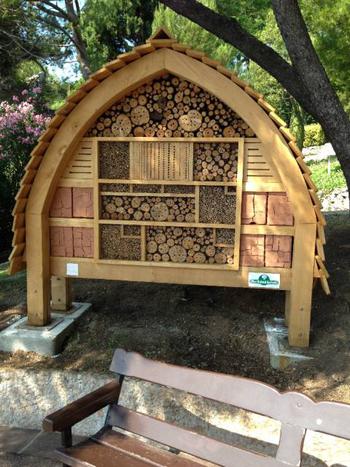
As a gardener, you probably want bugs for birds to eat & more native bees to pollinate your yard, meaning you'll need to provide housing (i.e., cover) for those bugs. What to do? Well, one way is to build an insect hotel!
We have already started one, and we'll keep you posted as it goes along. But I thought you'd enjoy some photos of absolutely lovely & amazing insect hotels (apparently they're quite a thing in Europe). Sunset magazine refers to them as yard art; they have some nice photos of tiny insect hotels (more like insect inns).
Also, at the bottom of this post you'll see some links to "how to" pages.
Online how to guides:
1. Permaculture.org's How To page
2. BBC Wildlife provides a downloadable PDF
3. Pacific Horticulture magazine provides one, too
Note that all have great photos, too.
As a gardener, you probably want bugs for birds to eat & more native bees to pollinate your yard, meaning you'll need to provide housing (i.e., cover) for those bugs. What to do? Well, one way is to build an insect hotel!
We have already started one, and we'll keep you posted as it goes along. But I thought you'd enjoy some photos of absolutely lovely & amazing insect hotels (apparently they're quite a thing in Europe). Sunset magazine refers to them as yard art; they have some nice photos of tiny insect hotels (more like insect inns).
Also, at the bottom of this post you'll see some links to "how to" pages.
Online how to guides:
1. Permaculture.org's How To page
2. BBC Wildlife provides a downloadable PDF
3. Pacific Horticulture magazine provides one, too
Note that all have great photos, too.
Thursday, October 23, 2014
It's Raining, It's Pouring, I'm Inside Adoring...
The good news today is that the National Agricultural Library has provided many of its historical files to the Biodiversity Heritage Library. (Read the announcement here.)
Why am I recommending you head on over & adore, too? Well, here are a few watercolors that are now available, for free, on the web, thanks to the high-quality digital scans. See if you agree!
There are also scanned documents, including historic USDA documents on organic farming (many from before 1942), and a Manual of Gardening for Bengal & Upper India, 1864 (no pictures, unfortunately).
(It's dry inside by my computer, not so much outside, though our ark is coming right along.)
Why am I recommending you head on over & adore, too? Well, here are a few watercolors that are now available, for free, on the web, thanks to the high-quality digital scans. See if you agree! There are also scanned documents, including historic USDA documents on organic farming (many from before 1942), and a Manual of Gardening for Bengal & Upper India, 1864 (no pictures, unfortunately).
(It's dry inside by my computer, not so much outside, though our ark is coming right along.)
Subscribe to:
Posts (Atom)